|
| Built by my father's parents', our ancestral house in Longmen, China, more than 200 years old (you can see from the woodwork and stone below). |
Copyright: Roger Pe
What if I died and never met Zhen Yuan, Lin Qing, Su Sulian, Jian Zhong and his wife Lin Qing, Bin Bin, Yu Yu, Huang Kai and the rest of my closest relatives in China?
I was told about having a brother (Zhen Yuan) and sister i(Lin Qing) in China when I was a child but my Filipino siblings did not know where to get in touch with them. Over fifty long years, or maybe longer, way past my childhood, an entire life lived without seeing them from ground zero. They would have been completely wiped out and forgotten. But that did not happen. I could only thank God, and words are not enough to also thank Pe Clan Facebook Page, social media and, well, yes, my insomnia.
From the start, verifying the news was like passing through a dark underground highway, an emotional rollercoaster even when you see the light at the end of the tunnel. "What if it was a joke?" was a question I didn't want to entertain. But it kept ringing in my ears.

And then I actually heard Lin (my sister) on the phone.
Looking back, everything is now immaterial. People I live every day, who label people, and struggle with every single day don't matter anymore. They are now irrelevant to me and have no part in my story. Who cares about them now when you have a loving family? Today, I have learned that no matter who you are, what you are, where you came from is not important. What matters most is what you have become and learning to know what is essential and inconsequential. I have found my family.

December 23, 2016
NAIA 3, Manila, before my plane took off for China:
I will make this less melodramatic. Advance Merry Christmas, to all of you, my FB friends. Thank you all for your good wishes. I am dropping everything, yes, everything, even spending Christmas in the Philippines - for something special.
NAIA 3, Manila, before my plane took off for China:
I will make this less melodramatic. Advance Merry Christmas, to all of you, my FB friends. Thank you all for your good wishes. I am dropping everything, yes, everything, even spending Christmas in the Philippines - for something special.
In a few hours, I will be in Xiamen, then to China mainland, and finally to Anxi, China's tea capital where my relatives live.
Inside my luggage are two disposable winter jackets hurriedly bought from a Makati Square Ukay-Ukay store (cheap, 200 pesos each), boxes of Philippine dried Mangoes, pastillas, other pasalubongs and some bundles of newspapers, hahaha!
How will I get by in China? Adventure. But it's nice to know that my two nephews will fetch me at the airport and will hold a banner with my name on it. That makes me a little less anxious.
My father left a wife and two young children in China when he and his cousins left Amoy, (now Xiamen) China after the war. Perhaps, he promised them that he would return. He never did. He died when I was 11 years old in the Philippines.
This Christmas, I will be seeing one of ‘two young children’, Chin Yan, my Chinese half-brother who is now about 84 years old. It would be perfect to meet the other one, Lin Qin, my half-sister, but she is currently in the US visiting her youngest son.
No, I don’t want to call them half-brother or half-sister. Regardless of their status in life, they are my family and I am now complete.
I have never met them nor seen their pictures previously. Facebook led me to their existence through an exhaustive family tree search, and finally on an accidental trip to Anxi on November 2016. Chin subsequently informed Lin, who, together with her daughter-in-law, Christina, initiated a series of calls and emails to contact me.
 |
| Proud of my grand nephews and a niece whom I met for the first time on Christmas Eve dinner. Young professionals, product of hardwork. Couldn't help but get misty eyed. LLL Lin could not speak English. I could not speak Mandarin. But the moment she spoke on the phone, I instantaneously knew she was my sister. I could only express my feelings with “How are you?” “Thank God, we finally met” and “I love you”. In between her long silent pauses and tearful “hao, hao … hao” mutterings, a tear rolled down my cheek. In photo: Lin and her son's family in San Jose, California. |
 |
| My sister Lin's youngest son with his wife Christina and his family in San Jose, California. I hope to meet them in February this year. Before my China trip, Lin and Christina called me many times to make sure that my trip to Xiamen would not suffer any hitch. Christina was very helpful and kind to make me feel I am part of the family. |
December 24, 2016:
From three different cities (Nan-An, Anxi, JinJiang) my brother’s family convoyed to Longmen, a village exactly the opposite of industrializing Xiamen. After one hour of driving, we stopped at a commodity store.
I had thought we were going to get bottles of water but Jian Zhong, my nephew, told me to follow him to an old house nearby. I was introduced to a woman who kept glancing at me with curiosity I felt awkward.
As they continued to talk, the stubborn rule breaker in me anxiously sneaked inside. A pre-war bike caught my attention. A padlocked room gave me the chills. A feeling of serendipity, I reckon.
Further right, as I strayed, I came close to an enclave that looked like an altar gathering dusts with mounds of ashes from burnt sticks of incense. Moving closer to the centerpiece, three pictures came to my view. The one in the middle made me choke. It was my father’s. At this point, I can hear everyone’s footsteps and I rushed outside, only to reemerge after about two minutes. What happened next? What happened in the village stays in the village.
 |
| My "Kuya" (Brother) Chin Yan |
As they continued to talk, the stubborn rule breaker in me anxiously sneaked inside. A pre-war bike caught my attention. A padlocked room gave me the chills. A feeling of serendipity, I reckon.
Further right, as I strayed, I came close to an enclave that looked like an altar gathering dusts with mounds of ashes from burnt sticks of incense. Moving closer to the centerpiece, three pictures came to my view. The one in the middle made me choke. It was my father’s. At this point, I can hear everyone’s footsteps and I rushed outside, only to reemerge after about two minutes. What happened next? What happened in the village stays in the village.
In the olden days, traditional Chinese houses had a courtyard (a multi-purpose space for family get-togethers) and a permanent fixture – an altar to remember members of the family who have passed. As for the picture, I will post it on Father’s Day. It will be private for now. My family in China: The best in the world. Xie xie, wo ai ni.
 |
| My precious, loving family in Anxi. |
 |
| Two Journalists in the family, Bibby, my super-busy grand nephew, and that's the sleepless, tired and haggard-looking me (ugh). Am so proud of this boy honor graduate of Journalism from Xiamen Tan Kah Kee University. |
 |
An 80-year old heirloom, my father's dowry to his Chinese wife before their wedding day. done in his apartment while his wife Su Shulian served me crunchy, delicious Guava slices. |
 |
| 1,000 year-old river moat, just across Jian's apartment in Anxi. A stone marker names it "Millenium" because of such. A beautiful park frequented by people from all walks of life to jog, stroll, sit around or watch the world go by. |
 |
| Anping Bridge, a national landmark and major tourist attraction in China. |
 |
| Bin Bin (Bibby) |
 |
| Chen, (Jian's brother) and his growing family, taken from the family album. |
 |
| Bibzy, taken at the foot of Yuzhamgshan Mountain Reserve |
 |
| My sister Lin Qin (seated, in pink dress with her daughters. At the back is my niece and her French husband (both are based in Nice, France but I met them on Christmas Day Family Lunch). We had a great chat getting to know each other. My niece (back row) even allowed me to sit beside them. My sister married a Huang and I was told that some of our descendants also migrated to the Philippines and once owned Corona Bazaar in Escolta, Manila. |
 |
| Self-portrait of my sister's fourth child and eldest son (his name escapes me at the moment), an accomplished painter and member of Fujian's Calligraphy Council, father of Huang Kai. I did not meet him personally but I hope I could when I come back because I love his painting style, classic Chinese or modern art. |
 |
His calligraphy pens in his studio in Nan-An City. Below are his other paintings.  |
 |
| Huang Kai, my 28-year old nephew. He travelled 30 kilometers to see me and invited me to the family Christmas Day lunch. His heart almost sunk when he misinterpreted that I wouldn't be able to make it. I replied, "Of course not, I will go with you, wherever you go." He brought me to his home and proudly showed me his father's awesome paintings. |
 |
| My nephew Jian Zhong when he was promoted as Sargeant in the People's Liberation Army. I feel bad I wasn't with him during his younger years, otherwise I could have come to China as often. He is the reincarnation of my brother Ruben who was killed in St. Bernard, Southern Leyte in 1983 and buried in Libingan ng Mga Bayan (Philippines' cemetery for heroes).  Anping, China's longest stone footbridge, built in 1138. My brother's two sons, Jian and Chen, together with Lin and my niece Bibzy, brought me here after a hearty lunch the latter prepared (I particularly loved the Oyster omelet). After a long walk around the national park, I felt sad that Chen would not join our ride back to Anxi. He stayed in the park. Damn, if I could only speak Chinese and talk to him and spend a little time. That was the last time I saw him. He was the guy who gave a great handshake and pressed my hand so hard at the family dinner on Christmas Eve. |
 |
| Christmas Eve dinner, meeting my family was indescribable. |
 |
| Surreal. My happiest Christmas ever. First descendants of my Father and brother (beside me, with his wife Su Shulian). |
 |
| A bunch of nephews and nieces, I am so proud of what they have become, all achievers at young age. |
 |
| My hardworking Journalist nephew, Bibby. A no non-sense guy. He bought his father a car so his father and sister could drive it. But when he drives it, you know that he owns the car. He is chief news reporter at West Strait Morning Post in Xiamen and recently got promoted as in-charge of the publication's Breaking News section. I know how busy he is so I don't demand that he should answer all my emails. I gave him all the Yuan money I brought to China (bought from a money-changer in Manila) because his father would refuse it. Just the same, he refused it and gave me a hug instead. |
 |
| The French family side of a niece who got married to a Frenchman (the guy with a backpack). Taken after Christmas Day lunch. |
 |
| Bibby, Lin, Jian and (fat-looking me) before my flight back to Manila. |
 |
| Gorgeous sculptures infront Anxi City Hall building. |
 |
| Sketching session at the house of Lin Qing's brother, taken after our Longmen trip (natural hot springs foot spa). |
 |
| I am not a selfie-person and seldom want my picture taken. Just preparing to meet and mingle with the nephews. Taken at my hotel in Anxi, China whom they all paid for. |
 |
| My brother's modest home in Anxi. It may look old from the outside, but very nice and comfortable inside. |
 |
| Christmas Day Lunch, here is my sister Lin Qin's family in separate table. I wasn't able to chat and linger with them for a little while because of language problem. |
 |
| Anxi City Hall. It was freaking cold when I took this photo. People meet on its big frontyard every single night. |
 |
| Stonemarker to the gates of Yunzhangsan mountain tea plantation, with Anxi Tea Master Chen Liang Gu. |
 |
| My sketch of my nephew Jian, done in less than 15 minutes. I was very happy with the result and so was he. I must have done 15 sketches of all my nephews and nieces, family friends, including my brother's throughout my stay in China. Back in Manila, I was happy to learn that they all brought them to the frame shop. Below is Jian Zhong and his elder brother Chen. |
 
At Huang Kai's house, December 25, 2016.

Huang Kai
 |
| Taken infront of Anxi's Municipal Hall where my nephew Jian works. I particularly loved the way the building was designed. Wonderful piece of architecture, two thumbs up. At night, city folks, mostly the elderly, gather infront of the building yard, a big square, to do mass calisthenics and aerobics dancing.  |
 |
| My brother's wife Su Shulian. I like this sketch because I think I captured the way she smiled. She spoke a little all throughout our meeting. I loved the slices of Guava she served me while doing this portrait. |
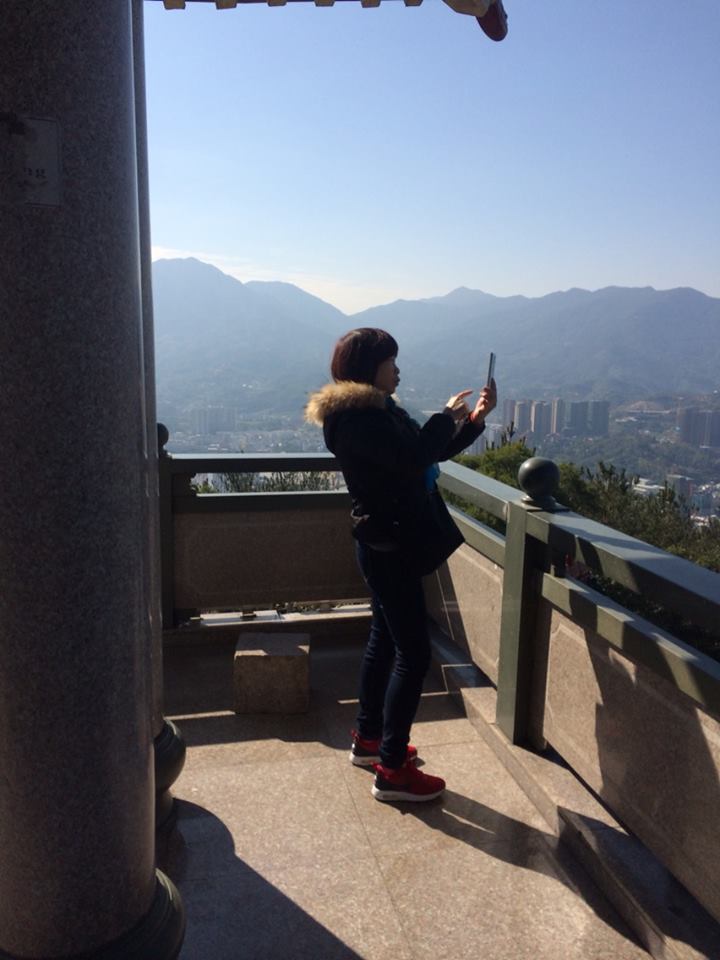 |
| Jian's wife Lin Qing, on top of a pagoda we visited overlooking Anxi on my last day of visit. |
 |
| Flower of a Tea Tree, very sweet. That's Bibzy's hand. |
 |
| They won't serve you tea in China if they don't feel that you are a friend and there's romance to the tea ceremony, cup after cup after cup. |
 |
| China's finest, highest-grade tea is grown in Anxi, no wonder it is the country's Tea Capital. That's Bibzy in the photo. |
 |
| My brother's other son, Chen. |
 |
| China's complex of mountain tunnels, jaw-dropping. |
 |
| World's biggest Tea Cup, photo taken in an Anxi park. |
 |
| Duck farm beside the ancestral house. |
 |
| Lin Qing, my nephew's wife. Done in an Anxi restaurant. One of my happiest dinner moments with the family, not because of the food, but the way they made me feel part of the family. |
 |
| Lin and Jian, I will never forget them. |
 |
| The Longmen ancestral house. |
 |
| View from Jian's house. |
 |
| Inside my father's house, shocked to find my father's photo in the altar. I broke down when I saw it. |
 |
| Bibby, my translator, treated me like no other. She cried at the airport and almost went past the airport check-in counter just to say goodbye. |
 |
| The altar in my father's house. My father's picture is in the middle. Though I knew of that photo a long time ago, I was not expecting it to be there. I immediately recognized him. He died in Palawan Provincial Hospital in Puerto Princesa (now a city) in 1966, isolated from the rest of the patients. When he passed away, my mother found him with tears in his eyes still warm. Perhaps, he was thinking of his children, that he would never see them again. We buried him in the town's Chinese cemetery with less than ten people attending. Not even his Chinese relatives mourned with us for reasons I don't know and don't want to know anymore. I came back to the town in 2005 to replace his old gravemark. |
 |
| Endless cups of tea. Taken at a rural eatery, atop a hill overlooking the beautiful cityscape of Anxi. Jian and Lin, I noticed were unusually sad, maybe it was my last day or, I don't know. I wish could read their minds. Before we headed for Xiamen, Jian stopped the car and showed me a condominium being constructed near his family apartment. I wish I could give what his heart and mind were thinking. |
 |
| Where my nephew Bibby works. Me and Bibzy went up the 12th floor to take a peek at the glass window of his office. I am proud of Bibby. I'd say it again and again. |
 |
| In the lobby of Anxi Municipal Hall. This area is so big it can occupy two basketball courts. To be continued. |